Showing posts with label Apple. Show all posts

Saturday, October 15, 2011

One Month And Counting Until Kindle Fire

Amazon warehouse in Glenrothes, Fife; source M...
I should be coding but that part of my brain appears to be fatigued right now so I'm taking a short break to write a few things down here about the upcoming Kindle Fire.

First up is the fact that I realized we're just one month away from the scheduled debut of the Fire. The coverage in the press has been kind of fascinating. It's an iPad killer, it's a panacea, it slices bread and does the dishes. On the flip side there has been some grousing about the fact that it only comes with 8Gig of storage and lacks things like cameras and SD card slots. Apparently the $199 price tag isn't enough of a clue for some people that this is a no frills device intended primarily for the consumption of media sold by Amazon.

According to some recent projections the Kindle Fire could ship five million units in Q4. That would be about 40% of what the iPad 2 is projected to ship during that same time period which may not sound impressive until you consider Amazon started from zero and that ASUS was overjoyed to sell just under three quarter of a million EEE Transformer tablets in the April->June quarter which put them at number two behind Apple.

Amazon isn't going to be able to deliver as polished an experience as Apple but they don't need to. So long as their build quality is decent and their custom Android launcher and apps are reasonably bug free they'll be off to a great start.

Actually another concern will be can they meet the demand? Limited delays in shipping are going to be OK, heck Apple thrives on 'em but Amazon doesn't want to leave too much money on the table here or cause excessive frustration to prospective buyers. They would be better off suspending pre orders once they get to the point where they aren't confident they can ship in time for Christmas.

With ten inch tablets rumored to be coming early next year Apple might finally have a legitimate competitor. (Or not, more on this topic below). 

It's not surprising that Apple chose not to compete in the 7 inch tablet space. It is a little ironic though that Amazon may use that hole in Apple's product line to leverage their way into a market that Apple has owned since the debut of the original iPad.

All this apparent success has led to speculation that Apple will come out with an iPad "mini". I'll say two things about that possibility:

  1. They already have one. It's called the iPod touch. 
  2. Apple is a premium brand. They don't and won't compete on price. Steve Jobs may be gone but it's going to take more than a few weeks or months for the people in charge to forget his vision and guidance.
Apple has always been content to let others chum at the bottom of the revenue pool. Amazon has thrived on low margins since its inception. These two companies couldn't be better suited to share the tablet space. Yes, there will be some overlap but I doubt it will be substantial enough for Apple to worry.

So basically Apple isn't losing here but the life of pretty much every other tablet vendor just got a lot more difficult.

I have Amazon prime and ponied up the nominal additional money for next day shipping when I ordered my Kindle Fire. I'm hoping to get it on day one of availability since I ordered within the first few days of the announcement. I'm sure I'll be one of about a million people posting first impressions within a few hours of getting mine.

Image via Wikipedia
Enhanced by Zemanta

Tuesday, October 4, 2011

Apple Day Predictions Fall 2011 (Short Take)

Apple iPhone 5Image by tychay via FlickrIt's a bit like an international holiday any time Apple is announcing new products. All the speculation and rumor mongering of the previous several months finally hits the wall of reality as Apple reveals exactly what they've been working on recently.

Speculation this time around has been typically rampant with contradicting stories circulating on what exactly the iPhone announcement will be. Could it be an upgraded iPhone 4? Will it be a totally new phone? Will Apple in fact announce two new iPhones, an iPhone 5 and an iPhone 4S with some upgrades and a lower cost? We'll know soon of course but my speculation is two new phones, one completely redesigned and the other a rehash of the previous generation. Both will be capable of running all the latest iOS5 features. The iPhone 4S will be dual mode CDMA/GSM while the iPhone 5 will also be dual mode and support HSPA+. The iPhone 5 will have a somewhat larger display both in terms of size and resolution while the iPhone 4S may only have a 5 megapixel camera instead of the iPhone 5's 8 megapixel.

I don't think we'll see Steve Jobs make an appearance but it would certainly be a welcome surprise if he did. Speculation on his health continues to run rampant and a personal appearance could potentially help ease shareholder and fan fears.

The big risk for Apple today is that people walk away going "Eh, not that impressive". If the new iPhone is just a rehashed iPhone 4 expect major disappointment.

Enhanced by Zemanta

Friday, September 30, 2011

RIM, PlayBook And More Kindle Fire

CHICAGO, IL - APRIL 19:  Blackberry Playbook t...Image by Getty Images via @daylifeSleep is good. I've always been a fan though I generally have to make up for my lack of skill with  enthusiasm and a good attitude. Thankfully I slept fairly well last night. That should translate into a little less mental fuzziness today. I can hope so anyway.

On the tech front I wanted to briefly discuss a couple of things before getting ready for work.

First on todays laundry list is a story focused on RIM and their Playbook tablet. You can find the text at the following link...

http://blogs.wsj.com/digits/2011/09/30/tech-today-rim-didn%E2%80%99t-know-what-to-do-with-its-tablet/

The gist of the story is that there was internal disagreement over who they were going to sell the Playbook to and over the direction the company was taking. Just a few years ago smart phones with almost exclusively used by businesses and RIM's Blackberry phones were king. Heck, they are still very popular in that space. People tend to focus to much on the fact that RIM's market share is slipping and not enough on the fact that the market for smart phones has been growing rapidly. RIM is a profitable company and will likely continue to be for at least a couple more years. What happens beyond that point is murky though and the Playbook scenario outlined in the linked story explains why. On the one hand you had people in the company that wanted to target sales at corporate customers. The advantage of this approach is that you can price the tablet higher and play to your strengths if your RIM. You're not going to sell as many as you would if you successfully rolled it out to the masses but your margins will be larger and you won't be going head to head with Apple. The other alternative is to try to sell it to everyone. If you're going to do that you need to price it a lot more aggressively.

Either approach might have worked. Sadly for RIM they chose to "compromise" and price it like they were selling to corporate customers while attempting to sell it though mass market channels like BestBuy. The results have spoken for themselves.

Cisco also brought out a tablet called the Cius this year. Haven't hears of it? No surprise there if you're not using Cisco's call manager it's not very useful and they aren't selling it to consumers. It's very expensive relative to the iPad but it isn't meant to compete in that space. It's only been on sale for about a month and I can't find any news stories about how Cisco is doing sales wise but they are following the strategy RIM should have if they wanted to charge a price that clearly made them a worse value than the iPad in the consumer space. Getting your targeting and message right is so important in this space. Trying to compete with Apple if you haven't done that is basically pointless and a good way to lose a lot of money.

The other thing is a bit about the Kindle Fire. There are apparently rumors that it's going to be in limited supply this year. Bezos said as much at his press conference when it was announced. If true there are likely two reasons for this. First of all Apple has used its excellent cash position and operational excellence to secure much of the manufacturing capacity that is available. This leaves Amazon and other tablet makers picking up the bread crumbs.

The second possibility is that Amazon never intended to produce that many of this version of the Fire. They may have wanted to get something out the door quickly and this was their best alternative. It's a capable platform but much like the first generation Kindle I suspect the subsequent versions will be more capable and elegant devices.

The end result of either of those two reasons being correct is we may see a limited supply of Fire tablets this holiday season so ordering early may not be a bad idea. I have my order in already as I believe I mentioned yesterday. Another thought is that scarcity has worked well for Apple and Amazon may be charting that same course for themselves in regards to the Fire.

Time to get ready for work and get a few other things taken care of. Have a great weekend!
Enhanced by Zemanta

Wednesday, September 28, 2011

Amazon On Fire (Short Take)

NEW YORK, NY - SEPTEMBER 28:  Amazon founder J...
This will be another quick and short post. I had the choice of getting close to enough sleep for the first time in three days or spending an hour on the BLOG. Sleep won out. It's been even busier than normal around here but things should be settling down a tiny bit over the next few days.

Amazon is a really smart company. How do I know? The proof is in the pudding as the old saying goes. Look at their bottom line, look at what they are doing to their competition and look what they announced today. I'm going to talk about the Tablet and hopefully cover the other parts of the announcement in the next few days.

Seven inch tablet, $199. Wireless only, and not that impressive hardware wise but a good device to test the waters. Will feature the Amazon store which is substantial and a select number of other Apps. Android underneath the covers but that doesn't really matter anymore than the fact that the E-Ink Kindles run Linux. 

I think Amazon is testing the waters here. The new Fire compares well to Barnes & Nobles $250 Nook. B&N are rumored to be bringing out a new tablet soon, and will now have to think very seriously about how they price it. Think of the first Fire as a test shot across Apples bow. It's not going to compete directly with the iPad as it lacks the apps and the form factor. If things go well for Amazon though it would be very feasible for them to introduce a ten inch version in the spring of 2012. They would be very competitive on the content front and would have a decent selection of Android Apps, particularly if they upgrade the underlying version to something more up to date. They won't be able to compete head to head on the apps, but they don't need to. If they could sell such a device for say $300 wireless and $375 with 3G they would likely be in good shape.

Apples success to date with the iPad has been primarily due to two factors. One, the rich content experience they can provide and two, the Apple name. This lead to a third advantage when developers flocked to the platform (following the money and the cool factor) and built apps.

Amazon isn't as cool as Apple but they arguably have a more diverse pool of content and have the potential if they manage their app store well and entice developers to create a platform that will have a substantial enough pool of applications to please the majority of people who might otherwise buy an iPad.

As with all things technology related we'll have to wait and see but this race is likely to be interesting over the next year.

Image by Getty Images via @daylife
Enhanced by Zemanta

Monday, September 26, 2011

Monday Morning Miscellany

Tokyo floodgates created to protect from typho...
The weekend was very productive, both in terms of getting stuff down around the house and my current side project/venture which I'll write more about later this week.  I'm a little slower than normal getting going this morning as a result though so this will be another short/scatter shot entry.

Topic one is Google+; which is now open to the general public. On the plus side Google has been growing rapidly since the flood gates opened. In theory people are still required to use their real names.  On the downside, I've seen several apparently real names posting random spam to topics with little or no relationship to the topic of the spam. Google does provide a button to report bad posts. It's unclear to me what effect that has though and the quality of discussion is certainly down since the flood gates have opened. Google is going to need some better spam controls in place ASAP if they don't want to annoy their existing user community. Their email filters are amazingly good, so hopefully they'll get something similar in place on Google+ soon. A growth of ten million plus users in this first week is good, but they'll need to have sustained growth if they want to challenge Facebook

On another Google+ related note Klout now supports Google+. I'm kind of excited about that as my level of engagement on Google+ tends to be high which should help my score. It's not that Klout defines who I am but it's nice to have it measuring pretty much everything I do online at this point. I gave up on Peer Index awhile back since they never seemed to be able to fix the problems with my profile. The forty point mark seems to be a magic value that a lot of Klout perks require. I've been hovering just below it for the past week or so. Hopefully this week is the week I push above and maintain at least that level.

I'll round things out with a rumor that Apple is cutting production of the iPad 2 and thinking of a price cut. My initial reaction is that this doesn't sound all that credible. Thinking about it a bit though it could be true. Even the base model isn't cheap, particularly when compared to small laptops that do a lot more but don't have the Apple logo. At this point the early adopters and Apple enthusiasts should all own an iPad so we're getting to the point where a drop in price might be needed to sustain sales. The other alternative would be introducing a new version and there have been rumors of that for awhile. I don't think we'll see a new iPad until next spring though.

Image via Wikipedia
Enhanced by Zemanta

Thursday, September 22, 2011

Not Everyone Is A Geek (Facebook)

My Social Graph
I'm pressed for time today so this one will likely be short, minimally edited and perhaps a bit more jumbled than normal logic wise. The topic is highly news worthy right now though and I really want to get something out.

Facebook is apparently going to release/announce even more changes today and many in the technical press are waxing poetic about how wonderful it is going to be. Great, I don't doubt that people who love technology are going to be impressed. Frankly though that doesn't matter because the vast majority of Facebook's seven hundred and fifty million users are not tech savvy geeks. They are just people who want to hang out with their friends and family and share the occasional thought or event. They want a platform that intrudes minimally on their ability to do that and each "feature" beyond that happy minimum clutters their experience and leads to confusion and frustration.

Those of use who are of a geeky persuasion have always made up a disproportionate percentage of the users on most online services. Yes, the representation online has broadened substantially in the past fifteen years but until Facebook there was never a site that appealed broadly to almost everyone.

Facebook isn't run by normal people. It's run for the most part by a core group that are under the age of thirty, highly tech savvy and very bright. That description matches a substantial percentage of the work force as well. They are creating features that they think are cool, and they are right. If you're under thirty and highly tech savvy. This isn't to say that there is zero appeal outside of that core group, but the amount of appeal is going to be much more limited for many of these new features.

This likely explains why so many people complain every time Facebook rolls out a new round of changes. Much of that complaining is just a fear/dislike of change which is much more common outside of the technical community than it is within. It's easy to dismiss those complaints as meaningless in the longer term but I'm not convinced they are. With each successive major overhaul it has seemed like the level of complaints have increased and the amount of activity I see on Facebook has gone down. Keep in mine that the vast majority of the people I hang out with on Facebook are over forty years old, as am I.

This latest round of changes seems focused on turning Facebook into an all inclusive platform, almost an OS. You could in theory create devices that ran Facebook as an overlay. Add an HTML 5 browser and you would never have to leave. I can see the appeal of that for tech types, particularly the tech types working at Facebook but will it appeal to the majority of their customers who just want to hang out with their friends with minimal clutter and noise?

Facebook owns the social graph. This is their biggest asset right now and a big part of the reason they've been able to get this far in the changes they are making. They risk is that they'll reach a tipping point where large numbers of people are no longer willing to deal with the changes and the complexity they introduce and start leaving. Are we at that point now? Too early to tell but I think we're close. The next month or two will be very interesting for Facebook and social networking in general.

I halfway seriously made a comment on Twitter in response to something I read that Apple should create a simple cross platform social network similar to early Facebook. Apple understands the importance of simplicity and could probably pull this off fairly quickly. They also have a large and seemingly ever growing legion of fans who are willing to at least try anything they bring out. Could they supplant Facebook with such a service? I'd like their chances more than I do Google's.

Image by krazydad / jbum via Flickr
Enhanced by Zemanta

Friday, September 9, 2011

Why I May Have Been Unfair To Apple In Regards To Their Fight With Samsung

With a post title that long I'd better write more than a paragraph or two on this topic. That shouldn't be a challenge. Making those words interesting... Well, we'll see.

I've criticized Apple in the recent past for what I view as an excessive amount of litigation. I still feel they are over the top in their patent litigation but it turns out that I may agree with them in regards to at least some of their litigation against Samsung over the Galaxy tab. It turns out that part of the disagreement is over trademark issues. Specifically what is referred to as "Industrial Design Right". We covered this as part of my MBA but that was a few years back at this point and I'm not a Lawyer so hopefully I'll get the details right.

The basic idea is that you can trademark the non functional aspects of a design. So for instance while you couldn't trademark the fact that a hammer has a handle, you could trademark a particular handle design that was distinctive to your product. The basic idea is that you are not supposed to be able to prevent others from building similar devices but you are supposed to be able to prevent them from building ones that look exactly like yours. Here's a picture of the Galaxy Tab 10.1 that I found on the web. Look closely at the shape of the case at the corners and how it is rounded.


Here is a picture of the iPad 2. the angle is a bit different but you can see that there are significant similarities between the iPad 2 and the Galaxy Tab 10.1


So Apple's point essentially appears to be that Samsung has created a product that from a visual perspective looks too similar to their product. Given Apple's attention to detail we can be sure that they've filed the appropriate paperwork to register their rights to this design.

The question is, can competitors make competing products that have the same basic functionality without infringing on Apple's industrial design right? The fact that Apple isn't suing ASUS, HP or other tablet makers in regards to this matter tells me that the answer to that question is probably yes.

The design elements of an Apple product are a big part of their appeal. It's easy for me to understand why Apple would feel a need to defend themselves if they felt a competitor's product was imitating one of their designs too closely. Apple is obligated to defend those rights if they want to keep them and I don't think imitating Apple's design elements this closely can be justified as "innovation".

The basic idea of the industrial design right is that it shouldn't prevent companies other than Apple from making tablets but it should give Apple the specific right to protect the unique design elements of their tablet. Has Samsung stepped over the line? Several different courts around the world appear to think they have so the answer to that question may just be yes.
Enhanced by Zemanta

Wednesday, September 7, 2011

Apple, The One Button Mouse And Gestures (Short Take)

Image representing Magic Mouse as depicted in ...
One of the things that has always frustrated me about Apple is the one button mouse. There is no doubt that Steve Job's is a genius in many different ways but that particular decision has never made sense to me. Yes, it's simple to the first order but it leads to additional complexity quickly in the UI as you have to make that one button do a lot. It's analogous to the difference between entering text on a full keyboard versus the old non smart phone keypad methods. It can be done, but it's not going to be as fast unless you spend a LOT of time gaining proficiency.

This approach is replicated on the iPad as well, though at least you have gestures and multitouch there. On the iPad it took me for ever to discover that pushing the button twice gives a list of running apps. Yes, I probably should have read the documentation but it's an Apple product and I'm a veteran geek, why should I have to? (That last sentence is meant to be somewhat but not entirely tongue in cheek).

I always feel like I've had part of my brain removed when I have to use a mouse with less than three buttons. Part of this is the fact that I still use the X-Windows system native to Linux/Unix on a regular basis. X uses all three buttons. No middle button means the normal paste functionality doesn't work. This makes coding and pretty much anything else a lot more difficult.

The thing I really find ironic is the fact that for some reason Apple/Jobs decided that multitouch on touchscreens is totally cool. In fact you can apparently do up to ten finger multitouch. They even have the magic mouse which apparently allows multitouch of some sort. Why is it user friendly and intuitive to use ten fingers on a touch screen but not more than one mouse button on a mouse?

OK, you probably could argue that touch and gestures are more natural to humans than pushing a button. I won't argue that point but is dealing with a button ten times more difficult than dealing with complex gestures that require a fair amount of dexterity and practice? It may be a sign of my age, but I'm still not all together comfortable with even two finger gestures. The thought that I can use three or more does not give me any comfort at all.

With the invention of devices like the Kinect though this is probably the general direction we can expect things to go in. Human computer interaction is moving away from the simple ones and zeros represented by button clicks and towards a more analog, or real world model. Having said that, the kinds of gestures currently supported by touch screens seem too abstract and complex to me. The Kinect essentially moves gestures from 2D to 3D. I'd expect touch pad like devices to have 3D gestures in the next decade. No doubt I'll be complaining about them as well if I'm right.

Image via CrunchBase

Enhanced by Zemanta

Monday, August 29, 2011

Some Monday Morning Thoughts

Old vs. New: Will internet search engines make...
It struck me again recently when I was reading the latest rumors about the iPhone 5 that Apple gets a lot of credit for being innovative when in fact most of the features you'll find in their products are anything but. There are exceptions of course like the Retina display but that is not the norm. In particular my phone is a year plus old at this point and has an 8 megapixel camera. Rumors are the iPhone 5 will match those specs. It seems likely that the iPhone 5 won't support LTE either. Where Apple wins is in their ability to integrate and create positive user experiences. As much as I love my Motorola Droid X, it does get annoying that I have to pull the battery periodically to hard power cycle it because it has gotten flaky. I have had to power cycle my iPad a few times but it's a fairly rare event.

Sprint employees have been asked to say "No comment" when asked by customers, family and friends about the possibility of the iPhone 5 coming to their network. This strikes me as a semi clever way of getting free advertising. Whether it actually means the iPhone 5 will be available on Sprint is difficult to judge. If it it is we'll see additional pressure on Android in the US. Apple's exclusive deal with AT&T in the beginning gave Google an opportunity to establish a foothold they might not have had otherwise so it makes sense from Apple's perspective to continue to "spread the love".

Dell is apparently the latest company to decide to get into the services side of cloud computing. Given their track record in other areas I'm not very optimistic about their chances. Other companies have been in this space for a lot longer and playing catch up at this point doesn't seem like a winning strategy even if they can execute and I have my doubts that they can.

I recently made my first virtual million on Empire Avenue. This was a cool accomplishment and one I'm kind of proud of. It took a fair amount of effort and a bit of thinking to get their and I've recently hit on a strategy that is giving me very good growth. I don't generally spend a lot of time on games these days but Empire Avenue has turned out to be a good investment in that I've made some great contacts and really stepped up my game on the BLOG and social network interaction front. It's nice to have some motivation to engage and an outlet that both encourages that engagement and gives me tools to help judge my effectiveness.

Speaking of social network engagement, my Klout score has been taking a bit of a hit recently and I'm not entirely sure why. I'm going to guess algorithm changes that aren't favorable to my model of engagement. I'm not going to worry too much about it but it's always disconcerting when a score goes down and I'm not quite sure why.

Image via Wikipedia
Enhanced by Zemanta

Thursday, August 25, 2011

Steve Jobs (Short Take)

Apple Inc
It's not hard to figure out what the obvious topic for today is. It's been interesting and occasionally encouraging to read the various news accounts about Steve Jobs stepping down as CEO of Apple. One I just read claims he worked a full day yesterday at Apple. That would be great if true because it would at the very least argue that he's not on deaths door as most people seem to be assuming after yesterdays announcement.

Still, most signs point to the fact that he is in fact human and that his health is not improving. I've admired his company and his effectiveness as a business leader for many years now. He's not perfect but he's done more than pretty much anyone else and he's managed to accomplish all that while doing less harm than most people who have amassed large sums of money have managed.

He hasn't always had the Midas touch though, at least over the short term. The NeXT computer was a brilliant product that never actually gained the kind of market share it needed for long term viability. The original units were shipped with a very cool but slow R/W optical drive only, no hard drive. This combination was revolutionary given the time but did not make a good impression from a performance or reliability perspective and that didn't help the viability of NeXT. Other than the original AppleTV it's hard for me to think of any other even partial failures since then though. Of course NeXT was eventually absorbed into Apple and a lot of that technical DNA survives today. The MacOS X OS was at its start a port of Next's operating system.

A lot of people have been writing eulogies to Jobs. I'm going to choose to believe that his story isn't done yet. He's apparently still heavily involved with Apple and he's still on the board at the Disney company. He may just surprise everyone and stick around long enough to add substantially to his legacy.

Image by Phil Bradley via Flickr
Enhanced by Zemanta

Thursday, August 18, 2011

Why The iPad Needs A Keyboard (M.I.C. Keyboard Buddy Case)

I've had a combo Bluetooth keyboard/case for my iPad for about a month now and it's amazing how many times I've been approached by total strangers who want to know more about it. There are others but I use the M.I.C Aluminum Keyboard Buddy Case for the iPad 2.

From an aesthetic perspective it's a perfect match for the iPad. I've included some pictures here of my iPad in the case to give you a better idea of what it looks like.

From a functional perspective the keyboard works reasonably well. It occasionally needs to be power cycled because it either starts repeating the last key pressed or stops sending to the iPad but that happens maybe once or twice an hour tops. I'm not sure if that is a problem with the keyboard or bugs in iOS. I did briefly use a Microsoft keyboard with the iPad but that was awhile ago. I don't think I had these same problems but I could just be forgetting or the victim of small sample size in that case. It automatically puts the iPad 2 into low power mode just like Apple's smart covers.

The keyboard/case isn't a tight fit which is why I use an additional case from Timbuk2. That works great and is reasonably sized though a fair amount bigger than the iPad 2 by itself. It's an excellent combo to keep in my car so long as I avoid direct sunlight.

Most of the interactions I've had have been with wait staff at restaurants who are curious about the combo. Sometimes this has included staff who weren't even responsible for the table I was at. I'm generally very focused on whatever I'm doing so these encounters aren't being initiated by me. Yesterday I even had somebody follow me to the door of the restaurant I had eaten lunch at to ask me about my iPad/M.I.C keyboard combo.

When complete strangers are approaching me this frequently I start to suspect that the subject of their curiosity just might be a winning combination.

The iPad 2 by itself is still a conversation starter even several months after it's release but the level of interest has gone up ten fold easily since I've started using the M.I.C. Keyboard Buddy Case.

I would love to see Apple offer a keyboard like this for the iPad. It's pleasing to the eye and very useful if you want to turn the iPad into something a little closer to a real laptop. It's still not as flexible as a full on computer but I can do casual to intermediate content creation tasks now which has greatly increased the utility of my iPad 2 for me.

If I were Apple I'd move the charging/data port to the side of the iPad and create a docking station to interface with the iPad in some future version. This is essentially what ASUS has already done with the Transformer tablet though and Apple seldom imitates others.

The keyboard buddy is a visually outstanding product but somewhat flawed from a functional perspective. On balance I'm happy with the purchase and would recommend it for anyone looking to improve the functionality of their iPad. There are other options out there that might be better but I have no first hand knowledge of them.

The M.I.C. keyboard buddy is worth the $50 I paid for it. You're mileage may vary though.

Enhanced by Zemanta

Wednesday, August 17, 2011

Google/Motorola Mobility/Synergy?

Another view of the south side of the Googlepl...
The first thing that jumped to mind when I heard about Google's acquisition of Motorola Mobility was the thought that I talked a lot about Apple and Intel in my last column but if you read between the lines I was also talking about Google and more specifically Android.

Apple has been waging what looks like an increasingly aggressive litigation/patent campaign against Android  as has Microsoft. I talked a lot in that column about how legal scuffles can become an unproductive distraction for technology companies but I neglected to mention the fact that your competition is eventually going to have to react if they want to stay in the game. Google has already claimed in the press that this purchase was motivated by what they view as anti-competitive practices by Microsoft and Apple.

There has been some cynicism expressed in the press over positive press releases by  Google's partners and soon to be competitors in regards to the Motorola purchase. What those cynics fail to take into account is that given recent trends Android was in danger of being taxed out of existence via licensing fee demands that partners and Google were ill prepared to defend against. Having Google as a competitor probably isn't something their happy about but Google now has even more skin in the game and an arsenal of their own patents to use in defense and negotiations. It's legitimate for Google's current channel partners to fear that preferential treatment will be given to Motorola which will create an advantage that allows them to grab the bulk of the highest margin Android sales but that is a remote and manageable scenario. Android's steadily increasing litigation and licensing "tax" burden was already eating their margins. Google may become a frenemy but that is still an improvement on the current situation.

I've also read claims that this is a precursor to Google making Android a closed platform and going it alone. That is a really absurd claim for the following reasons. First, Motorola and Android wouldn't stand a chance if they took on Apple mono a mono. Android's excellent market penetration is a result of being available on a wide range of platforms that no single company could possibly create or support by themselves. Second, that model is already in place at companies like Nokia and RIM and how well are they doing right now? Why would Google want to replicate a clearly failing business model when they already have a winner?

It is possible however that this purchase will cause companies to take another look at Microsoft's current and future mobile offerings so they can hedge their bets. Microsoft's close relationship with Nokia is however very similar to how Google is proposing to operate with Motorola so it's difficult for me to understand why this would be an improvement, particularly given the minimal market penetration of Microsoft's Windows phone 7.

I'm going to go out on a limb here and say that Microsoft will buy Nokia within a year. Consolidation and increased vertical integration are clear trends in the mobile space and Microsoft/Nokia are already on their way down this path.

RIM is going to need a major turn around in the next six months if they want to continue to go it alone and be anything but a niche player.

I'm trying to think of a polite word to use as an adjective to describe Standard & Poor's downgrade of Google but failing. Seriously, their logic is absurd. Will this deal guarantee that litigation against Android stops? Of course not but patent litigation is much easier to defend against when you are armed as well.  Prior to this acquisition Google was poorly situated to deal with legal challenges and had been losing ground steadily. Now they will be operating from a much stronger position.

There are no guarantees in business or life, but standing around and doing nothing in the face of challenges to a rapidly growing portion of your business is almost never a good idea. Another complaint S&P have is that this will impact Google's short term growth. Well yeah, when you spend $12 billion on something that does have a short term hit on your ability to take advantage of other opportunities. Particularly when you're going to have to wait around for the better part of a year for the deal to be completely consummated. It's not like Google is cash poor though and CEO Larry Page has made it clear that they play for the long term. That pisses off analysts who only care about a very finite horizon.

S&P's analysis in this matter is flawed at best. Every purchase is a risk and this one is no exception but Google is taking credible action to defend against a risk to both an emerging and established portion of their business as well as reacting to trends within the mobile computing/phone space.

Getting shut out of the mobile space would have meant getting shut out of the search engine space. The social networking paradigm shift is reducing but not eliminating the importance of search and Google couldn't afford to risk having that revenue stream cut off. S&P's Google downgrade feels more like an attempt to garner press than an honest and well informed assessment.

There is a risk that Microsoft or some other company will make a larger offer for Motorola Mobility. Apple is unlikely to do so since they probably couldn't get governmental approval for such a deal. Microsoft would be pissing off their channel partners but might view it as a worthwhile risk. I don't think they'll go this route but it's not outside the realm of possibility.

Image via Wikipedia
Enhanced by Zemanta

Sunday, August 14, 2011

Patentageddon/Apple/Intel/Etc.

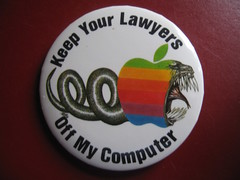
Apple:  Keep Your Lawyers Off My Computer
I'll admit it, I'm a bit idealistic. I have a strong pragmatic/practical side as well though so I'm not the type to talk about "peace and love" without putting up some kind of framework to explain/justify why I think a particular approach makes sense.

I'm also not totally anti patent. Patents were a noble experiment that made a lot of sense when they were first instituted and spurred innovation and progress. The reality today is all together different, particularly in the case of software patents which almost never make sense and do not encourage innovation or progress.

Some might argue that patents encourage a meritocracy. At this stage I think it's more accurate to say that they encourage a moneytocracy and Lawyertocracy which isn't good for anyone but the Lawyers in the long term.

It's one thing to acquire patents to protect yourself, that's just the cost of doing business these days. It's another to use those patents in an attempt to bludgeon your competition outside of the market place.
Apple seems to be the latest company to fall victim to the lure of litigation as a means to secure market positioning. They are hardly the first and they won't be the last. Still it's disappointing to see a company that is so strong in their core competencies of marketing and innovation go down this path.

Litigation can be a core competency if you want it to be but particularly for a technology company this seems like a mistake to me. Intel was known for their prowess in litigation for many years. Eventually they were also known for their mediocre technology and marketing which is why AMD was able to sneak up on them and usurp the architecture of the X86 processor family for several years. Which is in turn why we use AMD's 64 bit extensions in "Intel Compatible" processors including those made by Intel itself. As an aside, the Intel Itanium processor may have been a nice piece of technology but it was a lousy choice for Intel's customers which is why it never gained wide scale acceptance. From Intel's perspective it was great since it was going to finally kill off the clone processors that had bedeviled them for a decade plus at the time but outside of Intel that was viewed with ambivalence at best and outright hostility in many cases. Consumers like competition and choice. Short sighted companies don't and that works to their detriment.
Intel has pretty much always had around eight to ten times the financial resources of AMD yet time and again they've been trumped by the smaller company. Intel has done better in recent years but I contend they never would have gotten themselves into the messes they did if they hadn't spent so much time, energy and focus trying to eliminate their competition through the courts while failing to create as many innovate products as they should have. For example, Intel's inability to create a credible high end GPU is hurting them to this day.
This isn't the first time Apple has gone the lawsuit route in a big way. If you've been around for awhile you may recall their battle with Microsoft back in the late 80's and early 90's. When Jobs eventually returned to the fold Apple was weeks away from liquidating their remaining assets and going out of business. It would be unfair to assert that suing Microsoft was the sole reason for their near demise but I do think it was a pretty clear indicator that Apple was getting distracted and focusing energy in the wrong direction.

You have to keep an eye on your competition, that's common sense; but if you're not keeping the majority of your attention on your customers  you're making it easier for someone else to capture their hearts and minds. Apple's increased litigation against their competitors could be a sign that they are starting to lose their way again. Given their current very robust financial situation that isn't a big deal in the short term but I don't see how it can end well.

Image by mary hodder via Flickr

Tuesday, August 2, 2011

Apple iPhone/iPad/HDTV?

2010 Mac MiniImage via WikipediaFollowing Apple in the press is always interesting. When you're the number one technology company in the world it's very hard to hide what you are doing but somehow Apple manages. They are scary good at it.

There are some leaks but the tricky and fun bit is figuring out which ones are credible. Right now the iPhone and iPad tend to be the two products that get the most press. Here's what I think is going to happen with these products over the next six months based on the various rumors that have been circulating and my own intuition.

For the iPhone I'm going with a September announcement and an October ship date. I don't think we'll see a 4G phone but we will see dual band CDMA/GSM, a slightly wider screen and a less boxy form factor. The iPhone 4 was just plain ugly to me. Softening the edges would get them back to a more aesthetically pleasing design. I also think the rumors of a narrower bezel and wider usable screen are credible. The Core A5 processor should be a given as well.

There has been some debate as to whether the next iPhone is going to be enough of an upgrade to be labeled the "iPhone 5". That is purely a marketing decision. I think they will call it the iPhone 5. There will be enough upgrades to justify that naming and after waiting a year and a half people are going to expect it to be a big upgrade even if it isn't.

I also think there is a better than decent chance we'll see Apple release a new iPhone in June of 2012 called something like the "iPhone 5G" that will have one or more flavors of LTE baked in and modest upgrades to the CPU and graphics but otherwise be pretty much identical to the previous generation.

On the iPad front there have been rumors of a late 2011 update. I don't think this is going to happen. The iPad 2 was a big upgrade over the original iPad and it hasn't been out that long. The minute Apple releases an iPad 3 the iPad 2 becomes passe. We're all conditioned to waiting a year or more for upgrades to Apples major product lines and expect to be able to enjoy having Apples best product in a particular category for a full twelve months. Relatively minor updates that don't impact the aesthetic aren't as big a deal because they are essentially invisible.

The iPad 3 will probably be announced in March of 2012. I'd expect it to be a bit thinner, have a much higher resolution display and sport an upgraded camera, GPU and quad core processor plus at least one other feature that nobody has thought of but everyone will want. Yeah, I'm not being very precise with that last prediction. With Apple half the fun is the surprise and it wouldn't be a surprise if somebody like me could figure stuff out five or six months in advance.

There have been persistent rumors that Apple is going to start releasing HDTV's. Other than being a consumer electronics item I don't see the appeal of going this route from Apple's perspective. We tend to keep our TV's for five years plus or until they break. Apple has primarily been selling products with a two to five year life cycle up until now. A lot of their business is built on driving people to buy new product every couple of years. They've arguably been able to accelerate that time table a bit but they haven't fundamentally changed the consumer dynamic in the product spaces they work in.

If Apple does get into the HDTV business I'd expect them to have their first failure in recent memory. The Apple TV product has only recently become a modest success after a major revision and big price drop. Maybe they learned something from that experience and have what it takes to make a run at the TV business but I have some serious doubts.

Enhanced by Zemanta

Friday, July 29, 2011

Apple/Why 30% Is A Lot Of Money

Hypothetical project finance schemeImage via WikipediaI won't lie, finance was not my best subject area when I went back to school and earned my MBA. It looks like simple addition and subtraction but appearances are in fact VERY deceiving. Yesterday I threw the word margin around a lot. I know what the word margin means, but I'm a little unsure if it was the right word to use in that context. It probably would have been safer to insert the word "profit" in front of margin whenever I used it. having said that, on with the show...

I'm going to take a bit of time today to illustrate why 30% is a lot amount of money for Apple to be extracting from transactions that involve products with relatively high per unit costs to the companies who are selling them.

My examples will be based on what I know (or think I know) about the Martin guitar company and how their instruments are typically bought and sold.

The Martin Guitar company is rumored to sell guitars to their dealers at 50% of their published retail price. Since the 1960's knowledgeable buyers have expected and been able to get 40% off of the MSRP  if they shopped around a bit or knew of a dealer who was willing to honor that mark down.

Lets assume Martin has a guitar with an MSRP of $1000. They sell it to their dealers for

$500

Knowledgeable purchasers know that they can find a dealer who is willing to sell for 60% of the MSRP which would be

$600

In this case the dealer pockets $100 from this transaction. Note there are additional costs such as labor and warehousing but we're going to ignore them. $100 is 20% of the shop owners $500 investment. That's not a bad return, particularly if you can turn your inventory over quickly.

Now lets pretend that the guitar was sold via an iPad running a custom App that the dealer created. In that case the numbers would be as follows.

Dealer pays

$500

Buyer pays

$600

Apple gets 30%*$600 which would be

$180

Dealer gets

$600-$180

which equals

$420

of revenue on their $500 purchase. This is a net loss of 16% for the dealer. Clearly you couldn't stay in business based on that transaction.

Lets assume though that you can find a few customers who are willing to pay 75% of the MSRP. This is possible since 25% will seem like a decent discount to shoppers who are not familiar with how this market works.

In this case the guitar sells for

$750

Apple gets 30%*$750 which would be

$225

If we subtract Apple's $225 from the sale price...

$750-$225

would equal

$525

OK, the dealer made a profit, albeit a very small one at 5% ($25/$500). Meanwhile Apple pockets six times as much money and had zero skin in the game money wise. Not a bad racket at all. In the case where buyers are paying 60% Apple would get half the profits by taking just 5% of the transaction. As an aside, this is also why even a 1.5% transaction fee by credit cards can cause some companies distress. If you're profit margin is 3% a 1.5% charge is going to eat half your profits.

Lets put these two scenarios into a handy little table.

Profit @  |W/Apple |Direct
60% Retail|-16%    | 20%
75% Retail|  5%    | 50%

Inserting Apple into this equation is clearly not a win for the dealer under normal circumstances. If Apple has a big pool of potential customers who don't mind paying MSRP it might be though. In that case the picture looks pretty good for the dealer as they would make $350 on the sale of that $1000 MSRP guitar which would be a 70% profit margin. I'm not going to go through the math on that one but it should be fairly straight forward based on the examples above.

People who buy Apple products tend to be more affluent than average, but they also tend to be knowledgeable about how pricing works in the real world so if I were a dealer I wouldn't invest in an iOS app under the assumption I'd find a bunch of customers willing to pay retail or anything close to it.

As I said in my previous entry none of this is a surprise to Apple. The 30% isn't about collecting revenue in the case of this type of transaction. It's about eliminating their competition and creating an opportunity for Apple when they need to add some additional dollars to their bottom line. By creating this opportunity for themselves they are eliminating choice for their customers and creating a coercive relationship with both their customers and their potential competition/partners.

Enhanced by Zemanta

Thursday, July 28, 2011

Apple/Vendor Lock In/Not For Me

iPad Display ItemImage via WikipediaYesterday I explained why I don't own an iPhone. In the process of doing that I touched on something I want to explore a little bit more.

One of the reasons I cited was Apple's 30% tax on any purchases made by way of an application. If you're selling a magazine or other purely electronic piece of media and you own all the rights to your content that isn't necessarily a bad deal. This is because there are high fixed costs to producing the first copy of an electronic magazine but after that the incremental cost of selling another copy is nearly zero. Note, I'm not an expert on magazine publishing but the two times I sold an article I got a check up front and there was no additional per copy payment. So, if Apple provides  a way to put your product in front of millions of prospective new customers that 30% just might be a very attractive proposition. In cases like this I think Apple is being fair and reasonable as they are providing a potentially lucrative channel and want to be compensated for that.

The case for book publishers isn't quite as clear cut. They still have high fixed costs up front but in most cases they also have to pay royalties to the people who produced the work they are selling. I have no clue what a typical royalty on a book is but it's probably enough money that paying 30% of the gross sale price for a book to Apple is a bit of an unpleasant experience  having a viable alternative to Amazon probably makes that pill easier to swallow. Again, if Apple is charging 30% it's a reasonable deal.

Where we run into problems is when Apple tries to apply that % to companies like Amazon who are selling a wide variety of products including items that are not electronic in nature. Amazon's margin on products of that kind are small and are being squeezed as Amazon attempts to expand in a tough economy. This is easily proven by the fact that they had a 50+% revenue increase year over year in their most recent quarter but saw a drop in profits.

Amazon sells a lot of different things, including Apple products like the iPad. I very much doubt Apple is allowing Amazon a 30% margin on those items.

There was a time when 50% margins were common for retailers. Even before the advent of the world wide web and the consumer friendly increase in competition that it created average margins were in decline. Sam Walton built an empire with Wal-Mart and Sam's Club by squeezing margins down to 5% or less while still making a tidy profit.

So, clearly it's not feasible for companies like Amazon to pay 30% to Apple for most of the stuff they sell.

Obviously Apple isn't stupid. They know this. The fact that they are insisting on imposing this kind of fee tells me that they aren't actually expecting to collect much if any money in this case which means they have a different outcome in mind and it's not one I'm interested in being a part of.

One of the less clever things that most companies do at some point is to try to subtly or not so subtly lock us into using their products or services. Logically enough this is called "Vendor lock in". The reason I describe it as less than clever is that it's basically a coercive approach that works against the interests of a businesses customers. When you work against the interests of your customers those customers eventually get angry and frustrated. When that happens you're in trouble no matter how high you've built the walls around them. The only sustainable method to lock your customers in is to constantly please them. When you depend on any form of coercion you're building a dysfunctional and one sided relationship that will fail eventually.

Apple has established an impressive ecosystem with iTunes and the app store. They make boatloads of money off of their hardware but the hardware is just part of the picture. Apple also wants to sell us stuff. So far they've primarily sold us music and applications but you can be sure they'd like to sell more than just those items.

So, lets assume that Apple would like to sell us anything and everything like Amazon. They might brand such a venture the "iStore". Forcing Amazon and other similar companies out of the Apple ecosystem would reduce/eliminate competition for the iStore. In the short to mid term this would be great for Apple as they would benefit from not having to share their pool of customers for such purchases. They wouldn't even have to take advantage of their monopoly to charge higher prices. Just having 100% of the potential market increases their bottom line.

The long term problem with this approach is that consumers aren't stupid and when you start to depend on building walls around them they eventually become unhappy and look for ways to escape. I tend to be one of the first people out the door in this situation.

Apple used to be the plucky and smart underdog. This is changing. They are dominant in the Tablet space, control a substantial portion of the smart phone market and own the lions share of the revenues there and continue to see growth in their share of the PC market. This kind of success can be tricky for any company to maneuver. If you're publicly traded the problems only compound. Apple's financial performance over the past several years has been amazing and unprecedented. They are under an immense amount of pressure to continue to execute and grow. That kind of pressure can lead companies to do things that aren't always in their or their customers best long term interests. I think Apple's attempts to drive off competition and lock their customers in is an example of that scenario playing out.

All of which explains why I'm off the Apple bandwagon for now. I will not support a company that removes my ability to choose and uses their dominant position to strong arm their competition out of the picture. You win on innovation and quality or you don't win at all in my book.

Apple has consistently been a company that followed the high road in the past but it looks like they are starting to lose their way to me.
Enhanced by Zemanta

Wednesday, July 27, 2011

No iPhone For Me!

IMG_9218Image by hobnogs via FlickrAnyone that has read more than a few of my previous posts will know that I'm a big fan of Apple and their products. My wife and I have owned several iPod's, an Apple TV, an iMac and a couple of iPad's over the years. There is one product I won't be buying and that's an iPhone. Actually, I won't be buying another iPad either. There are two factors that drove me to make this decision.

The first is the lack of a native Google Mail client. Yes, you can use Safari to look at your Gmail and it kind of works but it's not close to the full experience of a native client and that really bugs me. I don't care whether it's Apple or Google that is primarily responsible for this shortcoming.

It doesn't end with GMail either. Google has apparently taken a dim view on all things Apple since their Google voice App got rejected. I need my Google stuff and I'd be willing to consider an iPhone if it were all there. Since it isn't, the iPhone loses.

Actually it would still lose because of problem number two which is Apple's insistence that in app purchases must filter through them so they can take a sizable cut. I understand the business driver behind this but I don't like it at all. Charging anyone who wants to sell stuff through an Apple device 30% is theft in my book.

One of the reasons Apple is such an impressive company is that their margins are very high. This isn't true of companies like Amazon and Barnes & Noble who have very small margins on most products. When your margins are 10% you lose a lot of money selling something and paying Apple 30%. We're already seeing companies pull back from providing in app purchases because of this. This means choices are being eliminated and I'm a guy who likes to have choices.

There is an hope though. HTML5, while still not an official standard is gaining a lot of traction. The capabilities of HTML5 are making it possible to present users with a browser experience that is very similar to a dedicated application. "The Next Web" is an online magazine that shows what is already possible with HTML5 on the iPad. It offers a clean and simple interface that doesn't look like a traditional web site at all. What this means is that companies that can't or won't pay Apples exorbitant tax have an option. So in theory we users of Apple products won't lose in the longer term because of the Apple tax. I have to wonder though if Apple is going to take some sort of action against companies that bypass them in this fashion. I can see that happening based on some of Apples recent moves and I want no part of it.

Apple is a great company with great products but they are starting to lose their way a bit in terms of how they approach their customers and their partners. If this doesn't change I won't be buying any Apple products in the future.
Enhanced by Zemanta